How to Stop a Dog From Barking: A Humane, Step-by-Step Guide
Quick answer
Start by identifying why your dog barks (alerting, demand, boredom, fear, excitement, or being left alone), then reduce triggers with management. Teach a reward-based quiet cue and use gradual desensitization for specific triggers. See a veterinarian for sudden changes and a certified behaviorist if barking comes with aggression or separation distress.

Barking is normal dog communication, so the realistic goal is less barking at the wrong times, not a silent dog. The methods that hold up best are the ones that treat barking as information. You figure out what the dog is reacting to, change the environment so the trigger shows up less, and teach a behavior you would rather see. The American Veterinary Society of Animal Behavior (AVSAB) recommends reward-based training for all dog training, including behavior problems, and this guide follows that approach.
Step 1: Identify the type of barking
Different barks have different causes, and the fix depends on the cause. Before you change anything, spend three or four days keeping a simple log: time of day, what happened just before the barking, how long it lasted, and what ended it. Patterns usually show up quickly.
| Type | What it often looks like | Likely driver | Main approach |
|---|---|---|---|
| Alert / territorial | Barking at the door, mail carrier, people or dogs passing the window or yard | Guarding space, being startled | Block views, quiet cue, desensitization to the trigger |
| Demand / attention | Barking at you while staring, often at mealtime or when you are on the phone | The bark has been rewarded before | Stop rewarding the bark, reward calm alternatives |
| Boredom / frustration | Long, repetitive barking in the yard or when left without much to do | Too little exercise or mental work | More physical and mental activity, enrichment |
| Fear / reactive | Barking with backing up, raised hackles, tucked tail, or lunging on leash | Fear or discomfort with a person, dog, or noise | Distance, counter-conditioning, professional help |
| Excitement / greeting | Barking when guests arrive or before walks, often with spinning or jumping | Arousal and anticipation | Calm routines, rewarding a sit or mat behavior |
| Separation-related | Barking or howling only when left alone, sometimes with destruction or house-soiling | Distress at being alone | Veterinarian and behavior professional |
Many dogs have more than one type. A dog can alert bark at the window and also demand bark at dinner. Work on the most frequent or most disruptive type first.
Step 2: Management, so the dog practices barking less
Every time a dog barks and the trigger leaves (the mail carrier always walks away), the barking gets a little stronger from the dog's point of view. Management cuts down those repetitions while you train. It is not cheating; it is what makes training possible.
- Block the view. Frosted window film on the lower half of a window, closed blinds, or moving the couch away from the front window removes a large share of alert barking for many dogs.
- Mask sound. A fan, white noise machine, or quiet radio can soften outside noises that set off barking, especially at night.
- Limit unsupervised yard time. A dog left in the yard alone often fence-runs and barks at everything. Go out with the dog, and bring it inside when you cannot supervise.
- Plan for predictable triggers. If deliveries come mid-afternoon, give a long-lasting chew or food puzzle in a back room at that time.
- Meet daily needs. A dog that gets a good walk, sniffing time, and some brain work before you leave for the day has less spare energy to spend barking. Our guide to mental stimulation games for dogs has ideas you can set up in a few minutes.
Step 3: Teach a "quiet" cue
A quiet cue gives you a way to say "thanks, I've got it" after a few alert barks. Humane societies commonly teach a version of it, and it works best for alert and excitement barking.
- Pick a word and a reward. Use a word you do not say often, such as "quiet" or "enough." Have small, high-value treats ready, like bits of cooked chicken or cheese.
- Set up an easy trigger. Have a helper knock softly on the door, or play a doorbell sound at low volume.
- Let the dog bark two or three times. Then say your cue once in a calm, normal voice. Do not shout; yelling often sounds like joining in.
- Wait for a pause. The moment the dog stops, even to take a breath, mark it with "yes" or a clicker and give a treat. Many dogs stop at first just because they notice the treat. That is fine in early sessions.
- Stretch the quiet. Over several sessions, wait one second of silence before rewarding, then three, then five, then ten.
- Move the treats out of sight. Once the dog responds reliably, keep treats in a pocket or on a counter so the cue, not the visible food, is doing the work.
- Practice with real triggers. Gradually use the cue with real knocks, passing dogs, and deliveries.
Keep sessions short, about five minutes, and end on a success. If the dog is too worked up to notice food, the trigger is too strong; make it quieter or farther away next time.
Step 4: Desensitization and counter-conditioning
For barking driven by specific triggers, especially fear or strong alerting, two techniques are used together. Desensitization means exposing the dog to a trigger at an intensity low enough that it does not react. Counter-conditioning means pairing that trigger with something the dog loves so its emotional response shifts from "alarm" to "good things are coming."
A practical example for doorbell barking:
- Record your doorbell on your phone, or find a similar sound.
- Play it at a very low volume, low enough that your dog maybe glances up but does not bark.
- Each time the sound plays, give a treat right away. Sound means treat; silence means no treat.
- Repeat 8 to 10 times per session.
- Over days, raise the volume in small steps. If the dog barks, you went too fast. Go back to the last volume that worked.
- Later, move the sound closer to the door, and eventually have a helper ring the real bell.
The same structure works for dogs barking at passersby. Start at a distance where your dog notices people but stays quiet, feed treats while people are in view, and stop feeding when they leave. Gradually reduce the distance over many sessions. The key rule is to stay below the dog's threshold, the point at which it starts reacting. Progress happens below threshold, not above it.
Step 5: Handle demand barking differently
Demand barking is learned. At some point barking produced dinner, a thrown ball, or attention, so the dog keeps trying it. The fix has two parts.
- Stop paying for the bark. Do not respond to it at all, including looking, talking, or scolding. Turning away or briefly leaving the room is clearer than saying "no." Expect an "extinction burst": the barking often gets louder for a short while before it fades, because the dog is testing whether more effort works. If you give in during the burst, you teach the dog to bark longer.
- Pay for the alternative. Decide what you want instead, such as a sit or lying on a mat, and reward it generously. Ask for a sit before placing the food bowl or throwing the ball.
Prevention also helps. If the dog barks at 5:30 every night for dinner, feed at 5:15 before the barking starts, or give a puzzle feeder that keeps it busy.
Step 6: Reduce boredom barking with exercise and mental work
Dogs bred to work, herd, or hunt often need more than a walk around the block. A bored dog finds its own job, and barking is an easy one. Useful additions include:
- Sniff walks, where the dog sets the pace and gets to explore scents
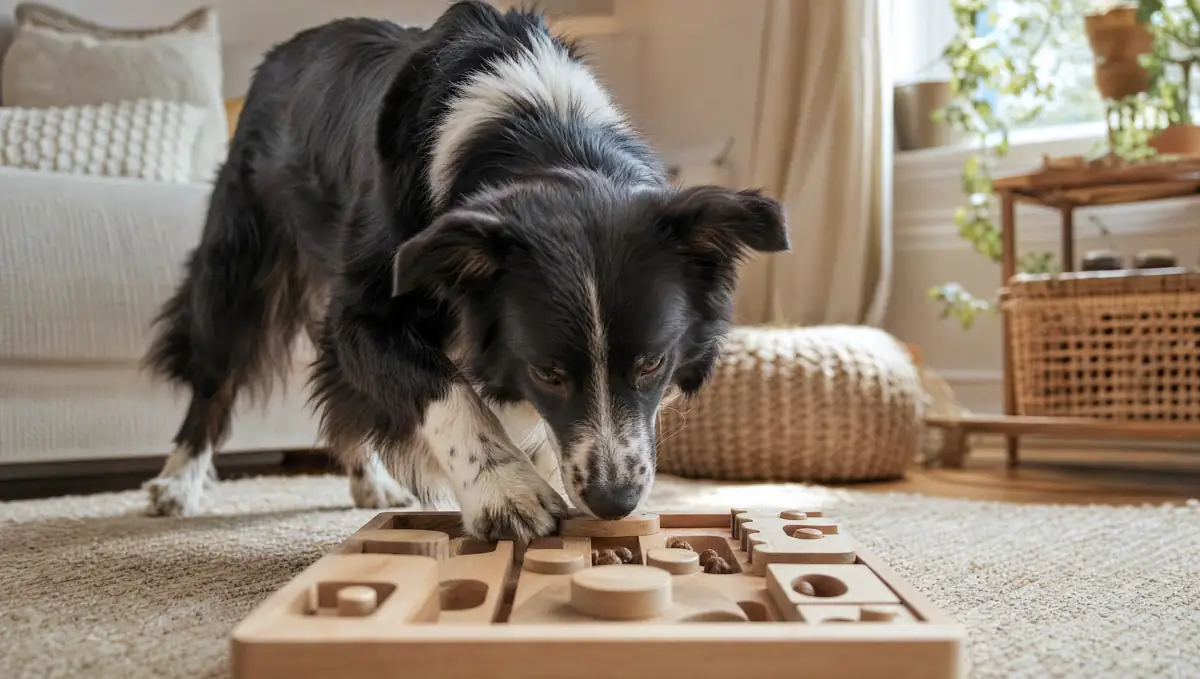
- Food puzzles and snuffle mats in place of a plain bowl
- Short training sessions, two or three times a day, for five minutes each
- Simple nose-work games like hiding treats around a room
Structured brain-training programs package this kind of work into a plan. If you want to see one option, our Brain Training for Dogs review covers what the course includes and who it suits. You can also browse more resources in our dog training category.
See the Brain Training for Dogs course
What to avoid
- Shock, spray, or vibration bark collars. AVSAB's position is that aversive methods are not necessary for training and can harm welfare and the relationship between dog and owner. These collars also do nothing about why the dog is barking, and a fearful dog can become more fearful.
- Yelling. To many dogs this sounds like you are barking too.
- Muzzles to stop barking. A muzzle is a safety tool for specific situations, not a barking fix, and a muzzle that holds the mouth shut can interfere with panting and drinking.
- Punishing fear. Punishing a scared dog for barking can suppress the warning without removing the fear, which can make a bite more likely later.
When to see a veterinarian or a certified behaviorist
Some barking is not a training problem. Talk with your veterinarian first if:
- Barking starts suddenly or changes noticeably, especially in an adult or senior dog
- The dog barks at night with confusion, pacing, or restlessness
- Barking happens along with signs of pain, such as limping, reluctance to be touched, or changes in appetite
Pain, hearing or vision changes, and age-related changes can all show up as new vocalizing, and only a veterinarian can assess them.
Look for a qualified behavior professional if barking comes with growling, lunging, snapping, or biting, or if it happens mainly when the dog is left alone. For aggression or severe anxiety, look for a veterinary behaviorist (DACVB), a Certified Applied Animal Behaviorist (CAAB), or a certified behavior consultant through the IAABC. They can build a plan that may combine management, behavior modification, and, where appropriate, input from your veterinarian.
A realistic timeline
Management changes often reduce barking within days because the dog simply sees fewer triggers. A quiet cue usually takes a few weeks of short daily sessions to become dependable. Desensitization for strong triggers can take weeks to months, depending on how intense the reaction is and how consistent the practice is. Progress is rarely a straight line, and a bad day does not erase your work. Keep a log so you can see the overall trend.
Frequently asked questions
Can you train a dog to stop barking completely?
Not realistically, and it is not a healthy goal. Barking is normal communication. The aim is to reduce barking that is excessive or happens at the wrong times, and to give the dog a cue that tells it you have noticed the trigger.
How long does it take to teach a quiet cue?
Many dogs start responding within a few short sessions, but a cue that works around real triggers usually takes a few weeks of daily practice. Strong or fear-based triggers can take longer and may need desensitization work.
Are bark collars a good idea?
Shock, spray, and vibration collars are aversive tools, and the American Veterinary Society of Animal Behavior recommends reward-based methods instead. Collars also do not address why the dog is barking and can make fearful dogs more anxious.
Why does my dog bark more when I ignore it?
With demand barking, dogs often bark harder for a short time when the old strategy stops working. This is called an extinction burst. If you stay consistent and reward calm behavior instead, the barking usually fades.
When should I see a vet about barking?
Contact your veterinarian if barking starts suddenly, changes noticeably, happens at night with confusion or pacing, or comes with signs of discomfort. For barking linked to aggression or being left alone, a certified behavior professional can help.